
Archives October 2025

Mainframe Automation Tools for Legacy App Modernization


Legacy applications continue to serve as the backbone of many enterprises across industries such as banking, healthcare, manufacturing, and government. These systems, often built decades ago, remain reliable but pose significant challenges when businesses pursue modernization. The challenges range from maintaining aging infrastructure to addressing the talent gap in legacy programming skills. Despite these issues, organizations hesitate to replace mainframes completely due to their unmatched performance and resilience. Instead, the solution lies in modernization strategies that preserve core functionality while improving agility, usability, and integration with modern platforms.

A critical factor in enabling this transition is automation. By combining human productivity signals such as collaboration, decision making, and workflow efficiency with advanced mainframe automation tools, enterprises can accelerate the modernization journey while mitigating risks. Automation not only reduces manual effort but also ensures consistent testing, validation, and monitoring across systems that are otherwise difficult to manage.

This article explores how mainframe automation tools drive modernization, the role of human productivity signals in shaping strategies, and how enterprises can balance legacy reliability with the need for innovation.

The Legacy Application Modernization Landscape

Why Modernization is Essential

Legacy applications hold vast amounts of business-critical data and processes. However, they present issues such as:

  • High maintenance costs for aging infrastructure and software
  • Limited compatibility with cloud platforms and APIs
  • A dwindling pool of developers skilled in COBOL or PL/I
  • Slower release cycles are incompatible with agile or DevOps practices

These factors not only create technical debt but also restrict innovation across the enterprise. Legacy systems often operate in isolation, making integration with modern digital tools or customer-facing platforms extremely difficult. As organizations grow, the inability to scale these applications efficiently results in operational bottlenecks, higher risks of downtime, and mounting expenses. Modernization is no longer a luxury but a necessity to remain competitive. It enables enterprises to adapt to customer expectations, regulatory changes, and digital transformation initiatives while also building a foundation for long-term resilience and agility.

Challenges Enterprises Face

While modernization brings promise, it also comes with risks:

  • Business disruption during migration
  • Loss of data integrity
  • Complex dependencies across applications and infrastructure
  • Difficulty in testing legacy environments without specialized tools

These challenges highlight the need for a structured approach to modernization that balances stability with progress. Without the right planning and automation support, enterprises risk stalled projects, frustrated teams, and costly rework that diminishes the value of modernization efforts.

The Role of Human Productivity Signals

Human productivity signals represent the measurable indicators of efficiency and collaboration in enterprise teams. When applied to modernization, these signals provide insights into how people interact with systems, processes, and one another. They serve as a compass for directing automation efforts in the right areas. By understanding where teams thrive and where they struggle, enterprises can make informed decisions about where automation delivers the most impact.

Examples include:

  • Decision-making speed is measured by how quickly teams can analyze results and act
  • Collaboration patterns across testing and development groups
  • Frequency of error detection during workflows
  • Time to resolution for addressing identified defects

These signals provide real-world evidence of how modernization initiatives affect productivity. For instance, if automation reduces resolution time or increases detection rates, the organization gains measurable proof of success. Over time, these metrics form the basis of continuous improvement by helping leaders adjust strategies, optimize processes, and better allocate resources. By blending these signals with automation strategies, enterprises can identify bottlenecks, enhance workflows, and ensure modernization projects align with business goals and measurable outcomes.

Why Mainframe Automation Tools Matter

Mainframes power essential business processes but are inherently complex. Manual testing and maintenance can be slow, error-prone, and resource-intensive. This reality often limits innovation and slows down modernization efforts. Mainframe test automation tools solve these problems by:

  • Accelerating regression testing
  • Reducing dependence on specialized skills
  • Supporting end-to-end workflows
  • Ensuring compliance and reliability
  • Driving agile and DevOps practices

Beyond these immediate benefits, automation also improves scalability and consistency across projects. It allows enterprises to handle large volumes of transactions with greater confidence while reducing operational risks tied to human error. Automated frameworks provide visibility into processes that were once opaque, helping leaders make better strategic decisions. With tools like testRigor, enterprises can transform testing by enabling plain English scripting, broader team participation, and integration with modern development pipelines, all while freeing teams to focus on innovation rather than repetitive manual tasks.

Blending Human Productivity Signals with Automation

Modernization is not just about automating tasks but aligning automation with human-driven insights. By weaving human productivity signals into automation strategies, organizations create a more adaptive and intelligent approach to modernization. Instead of viewing automation as a replacement for human effort, it becomes a force multiplier that amplifies decision-making and collaboration. Here’s how organizations can combine the two:

Identifying Bottlenecks

Human productivity signals reveal where delays occur, whether in test case creation, defect resolution, or release approvals. Automation can target these areas for maximum impact, ensuring teams spend less time on repetitive bottlenecks and more time on innovation.

Enhancing Test Coverage

Automation ensures repetitive tasks are handled consistently, while human teams focus on exploratory testing and high-level decision-making. This balance increases overall coverage and quality, providing a stronger safety net for modernization initiatives.

Streamlining Collaboration

Human productivity data highlights gaps in communication. Automation tools integrate with collaboration platforms to ensure transparency across QA, development, and operations teams. This creates shared accountability and smoother workflows across departments.

Prioritizing Risk-Based Testing

Signals such as error frequency and time to resolution help identify high-risk areas. Automation can then prioritize these areas, ensuring critical functions are thoroughly validated. Over time, this targeted approach improves reliability and strengthens confidence in modernization outcomes.

Benefits of Mainframe Automation in Modernization
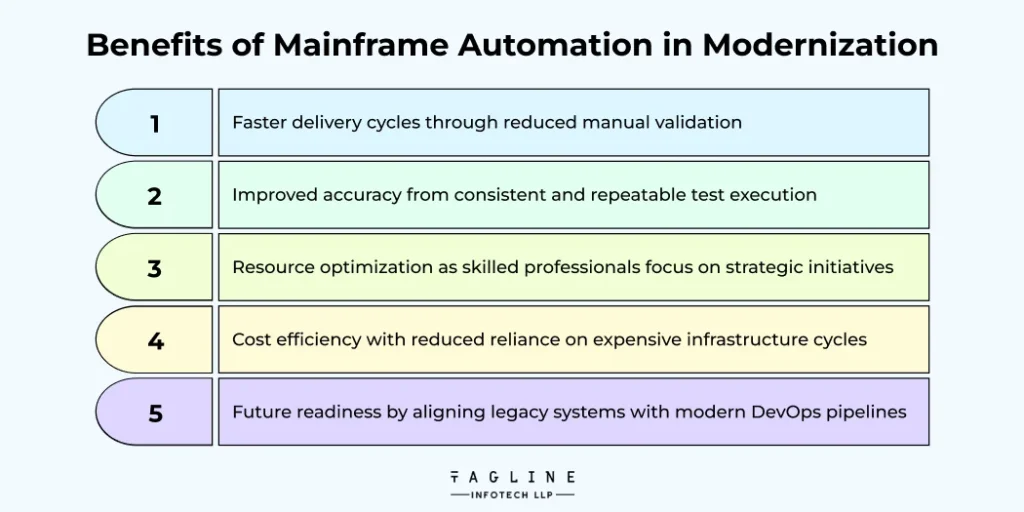
Benefits of Mainframe Automation in Modernization

Enterprises adopting automation for modernization projects can expect the following benefits:

  • Faster delivery cycles through reduced manual validation
    Automation shortens testing timelines and supports continuous integration, allowing enterprises to deliver new features and updates with greater speed.
  • Improved accuracy from consistent and repeatable test execution
    Automated tests minimize human error and ensure reliability across multiple environments, increasing confidence in system performance.
  • Resource optimization as skilled professionals focus on strategic initiatives
    Teams can devote more energy to innovation, product design, and customer-centric improvements instead of repetitive validation tasks.
  • Cost efficiency with reduced reliance on expensive infrastructure cycles
    Automation helps minimize MIPS consumption, lowering operational costs and extending the lifespan of critical systems.
  • Future readiness by aligning legacy systems with modern DevOps pipelines
    Enterprises gain agility, resilience, and flexibility, making it easier to integrate with cloud platforms, emerging technologies, and long-term digital transformation goals.

Ultimately, these benefits compound to create a competitive advantage. Organizations not only reduce risks but also position themselves to innovate faster, respond to market demands, and maintain stability while modernizing core business operations

Practical Use Cases

  1. Banking: Automating transaction testing to ensure compliance and prevent errors during modernization. Financial institutions can validate high-volume transactions, regulatory reporting, and fraud detection workflows without manual intervention, reducing risk while improving customer trust
  2. Healthcare: Validating patient data migration across mainframe and cloud-based EHR systems. Automation ensures accuracy in sensitive medical records, minimizes downtime for healthcare providers, and supports compliance with privacy regulations such as HIPAA
  3. Retail: Ensuring integration of inventory systems with modern e-commerce platforms. Automation enables real-time synchronization of stock levels, order management, and supply chain processes, ensuring consistent customer experiences across digital channels
  4. Government: Automating benefits processing systems to deliver timely citizen services. Automated validation ensures accurate eligibility checks, faster claim approvals, and reduced errors, all while improving transparency and efficiency in public sector operations

Across industries, these use cases demonstrate how mainframe automation provides measurable improvements in efficiency, compliance, and reliability during modernization efforts

Choosing the Right Mainframe Automation Tools

When selecting tools, enterprises should look for:

  • Codeless automation that empowers non-technical teams
  • Cross-platform support covering mainframe, web, and APIs
  • Integration with CI and CD pipelines
  • AI-driven insights for test creation and maintenance
  • Scalability for enterprise-level workloads

Beyond these essentials, organizations should also consider the long-term adaptability of their chosen solution. The best tools provide flexibility to integrate with evolving technology stacks, ensuring modernization efforts are not stalled by future upgrades. Strong reporting and analytics capabilities are also vital, as they allow leaders to measure progress and demonstrate value to stakeholders. Security should never be overlooked, especially in industries such as banking and healthcare, where compliance requirements are strict. TestRigor stands out by offering plain English automation, strong mainframe support, and the ability to unify testing across multiple platforms while keeping ease of use at the center of its design.

Future Outlook

As enterprises increasingly rely on hybrid systems combining mainframes with cloud native applications, automation will play an even greater role. The next wave of innovation lies in AI-driven predictive analytics, where systems proactively detect risks and recommend optimizations. Human productivity signals will evolve into actionable intelligence, making modernization strategies more adaptive and resilient.

In addition, the convergence of automation with machine learning will create self-healing systems that automatically adjust to errors without human intervention. Enterprises will also see closer integration of automation with cloud orchestration tools, enabling seamless scalability across diverse environments. Security testing will become an embedded part of automation frameworks, ensuring compliance is maintained even as systems evolve. As workforce dynamics change, automation will empower both technical and non-technical professionals to contribute to testing and modernization, democratizing enterprise transformation and accelerating innovation cycles for years to come.

Conclusion

Legacy systems will continue to remain integral to enterprises, but modernization is critical to achieving agility, innovation, and competitiveness. By blending human productivity signals with the power of mainframe automation tools, organizations can streamline modernization while minimizing risks. Automation not only reduces manual effort but also ensures accuracy, compliance, and speed, which are essential for successful transformation.

The combination of human insights and advanced automation ensures that enterprises do not just modernize for today but prepare for a future where adaptability defines success. Organizations that embrace this dual approach gain the ability to innovate faster, deliver better customer experiences, and remain resilient in the face of change. As business environments grow increasingly dynamic, modernization guided by productivity insights and enabled by automation will serve as a strategic advantage. In this way, enterprises protect the value of their legacy systems while unlocking new possibilities for growth, scalability, and long-term sustainability.

FAQ’s

Automation reduces manual effort, accelerates testing, improves accuracy, and enables integration with modern DevOps practices. It ensures consistency across environments and helps mitigate risks during migration or transformation.

Human productivity signals—such as collaboration efficiency, decision-making speed, and error resolution rates—help identify where automation has the most impact. They guide enterprises in aligning modernization strategies with measurable improvements in team performance.

No. While testing is a core use case, automation tools also support monitoring, compliance validation, workflow orchestration, and integration with APIs and cloud systems. They streamline end-to-end modernization efforts.


Finance

Agen Togel Terpercaya

Bandar Togel

Sabung Ayam Online

Berita Terkini

Artikel Terbaru

Berita Terbaru

Penerbangan

Berita Politik

Berita Politik

Software

Software Download

Download Aplikasi

Berita Terkini

News

Jasa PBN

Jasa Artikel
Comment l’IA aide les écrivains à rester originaux et éthiques


Êtes-vous souvent victime de violations des normes d’écriture comme l’originalité ? Si tel est le cas, c’est le moment d’essayer l’IA pour éviter ces problèmes. L’IA ne se limite pas à accélérer votre processus d’écriture. Cela implique également de vous permettre de rester original et éthique dans votre écriture. Vous vous demandez peut-être comment.

Eh bien, il n’y a pas de réponse d’un seul mot à cette question.

C’est pourquoi nous avons créé ce guide détaillé sur la façon dont l’IA aide les écrivains à garder leur travail unique, honnête et précis.

De plus, nous vous présenterons également certains des meilleurs outils d’IA qui contribuent à cet égard.

Alors partons pour un voyage hautement instructif.

Comment l’IA soutient-elle l’éthique et l’originalité dans l’écriture ?

AI offre un soutien dans divers domaines aux écrivains, les aidant à garantir que leur travail reste éthique et original. Examinons quelques-uns d’entre eux les plus importants et voyons exactement comment l’IA peut aider.

Détecter le plagiat involontaire

L’un des plus grands avantages de l’IA pour les écrivains est qu’elle les aide à détecter le plagiat accidentel.

Les algorithmes d’IA sont capables d’analyser et de comparer un texte de référence avec des millions de pages Web et de bases de données hors ligne.

Cela leur permet de détecter avec précision chaque partie plagiée. En conséquence, les écrivains peuvent identifier et supprimer le plagiat avant de soumettre pour garantir l’originalité.

Suggérer un meilleur choix de mots

Le bon choix de mots est très important pour montrer du respect aux lecteurs. Mais il n’est pas toujours facile de trouver une formulation précise. L’IA aide grandement à cet égard en vous permettant de reformuler la même idée avec des mots plus simples et plus appropriés tout en garantissant que le message reste intact.

Il vous permet même de personnaliser votre choix de mots en vous permettant de remplacer les mots par de meilleures alternatives.

Soutenir les citations correctes

Les citations jouent un rôle crucial dans le maintien de l’originalité de notre travail. Cependant, vous savez peut-être que les écrivains oublient souvent d’où vient un fait, un chiffre ou une statistique particulière. Cela peut vous amener à ne pas citer la source ou à la citer de manière incorrecte.

Cependant, l’IA peut découvrir les sources exactes ainsi que leurs URL contenant les mêmes données. De cette façon, vous pouvez vous assurer non seulement de créditer l’auteur, mais également d’éviter toute erreur de nom, d’URL et de date.

Offrir une aide à la recherche éthique

La recherche est un autre domaine important dans lequel l’IA offre sa contribution aux écrivains. Ceux qui évitent la recherche en raison du temps qu’elle prend peuvent bénéficier des réponses rapides et utiles de l’IA.

Il vous suffit d’informer AI de l’affirmation, de l’opinion ou du sujet particulier pour lequel vous souhaitez des preuves. Il vous fournira en quelques secondes des données crédibles provenant de sources fiables et faisant autorité.

Aider à la précision linguistique

La clarté n’est pas seulement une formalité mais une norme d’écriture. Cependant, les écrivains sont souvent victimes d’erreurs linguistiques, ce qui rend leur travail flou. C’est là que les outils basés sur l’IA, tels que les vérificateurs de grammaire, s’avèrent utiles. Avec de tels outils entre vos mains, vous pouvez repérer et supprimer les défauts grammaticaux sans trop d’effort.

Repérer les traces de l’IA dans l’écriture

Une autre chose pour laquelle l’IA aide est de détecter les parties de votre écriture qui sonnent l’IA. Les lecteurs n’aiment souvent pas le contenu qui semble généré par l’IA. Pourquoi? Cela montre que l’écrivain n’a pas déployé de réels efforts pour le rédiger. Mais l’IA vous donne la possibilité de retravailler ces éléments et de ramener un ton humain authentique et original.

Meilleurs outils d’IA qui aident les écrivains à respecter les normes d’écriture

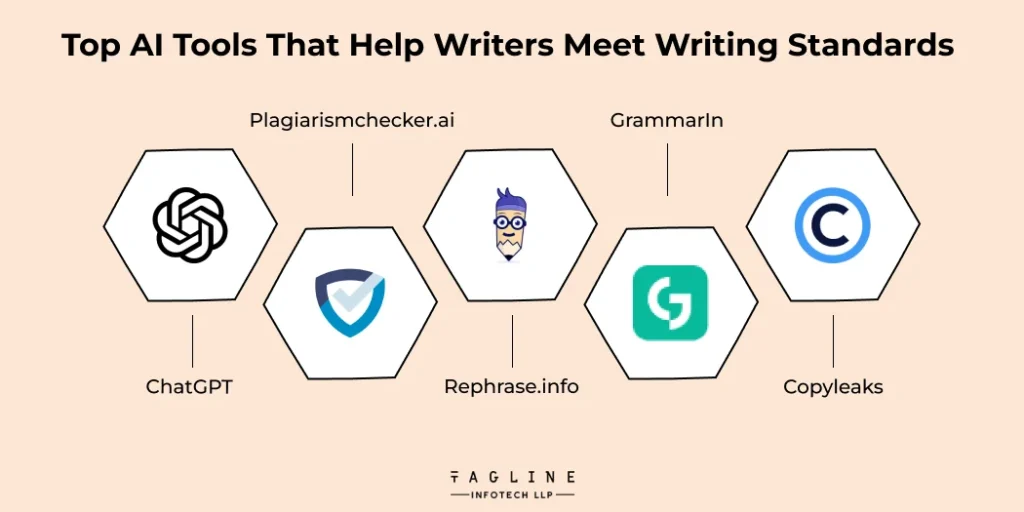
Meilleurs outils d'IA qui aident les écrivains à respecter les normes d'écriture

Voici quelques-uns des meilleurs outils d’IA qui permettent aux écrivains de rester originaux et conformes à l’éthique :

ChatGPT

ChatGPT, un chatbot IA largement utilisé, est comme un assistant d’écriture personnel pour les écrivains. Cela peut les aider à rester conformes à l’éthique de différentes manières. Il contribue principalement à des domaines tels que la recherche et les citations.

Chaque fois que vous vous sentez bloqué à un moment donné, parlez-lui simplement et dites-lui ce qui vous dérange.

Qu’il s’agisse de trouver de nouvelles idées ou de trouver la source d’un fait, cela vous aide dans diverses choses.

Principales caractéristiques :

  • Réponses rapides et contextuelles.
  • Converse dans plusieurs langues.
  • Utilisation gratuite pour les utilisateurs du monde entier.
  • Traitez à la fois les entrées de texte et d’image.
  • Une fonction de conversation vocale est disponible.

Plagiarismchecker.ai

Plagiarismchecker.ai a été spécialement conçu pour aider les écrivains à conserver l’originalité de leur écriture.

Avec ça détecteur de plagiatvous pouvez identifier si votre travail écrit correspond aux autres.

Les algorithmes d’IA de cet outil approfondissent le texte et identifient toutes les phrases plagiées en quelques secondes seulement. Cela permet aux professionnels de l’écriture comme vous de rendre uniques les sections plagiées avant de les publier.

Principales caractéristiques :

  • Vérifications gratuites basées sur l’IA.
  • Rapports détaillés de plagiat.
  • Analyses de texte rapides et précises.
  • Capacités de détection multilingues.
  • Compatible avec les formats de fichiers standards.

Reformuler.info

Rephrase.info est également un utilitaire Web basé sur l’IA qui prend en charge une formulation améliorée. Pour les écrivains, cet outil de paraphrase sert à simplifier et à améliorer le texte.

Il a la capacité de reformuler le même texte en utilisant un vocabulaire et des structures de phrases variés.

La meilleure chose est qu’il préserve les significations avec une grande précision. En conséquence, les rédacteurs produisent un résultat avec un choix de mots amélioré, adhérant de manière éthique aux normes d’écriture.

Principales caractéristiques :

  • 5 modes de paraphrase différents.
  • Pas de publicité ni d’encombrement sur l’interface.
  • Suggestions de synonymes basées sur l’IA.
  • Codage couleur en sortie pour une lecture facile.
  • Idéal pour tous les types de textes professionnels.

GrammaireDans

GrammarIn est un autre outil d’IA qui vous aide à maintenir des normes d’écriture éthiques. Il vous permet de vérifier la grammaire et assurez l’exactitude de votre texte.

Des fautes d’orthographe basiques aux erreurs plus complexes, l’outil gère efficacement tous les types de problèmes. Collez simplement votre texte dans la zone de saisie et il mettra automatiquement en évidence toutes les erreurs.

Principales caractéristiques :

  • Option de correction en un clic.
  • Mise en page totalement sans publicité.
  • Accessibilité sans obstacle.
  • Vérifications grammaticales gratuites et illimitées.
  • Prise en charge de différents dialectes anglais.

Fuites de copie

Un autre outil qui prend en charge une écriture honnête est le détecteur AI de Copyleaks. Cet outil est conçu pour aider les écrivains à déterminer si une section de leur écriture semble être générée par l’IA.

L’outil est suffisamment efficace pour détecter les traces de texte importantes et subtiles qui semblent générées par l’IA. Une fois identifiés, les experts en rédaction peuvent réécrire le même texte pour lui donner une apparence plus humaine et moins IA.

De cette façon, ils peuvent montrer que leur travail est véritablement réalisé par l’homme.

Principales caractéristiques :

  • Affiche l’implication de l’IA en pourcentage.
  • Utilise un code couleur pour mettre en évidence les pièces AI.
  • Fonctionne avec Chrome et Docs.
  • Prétend être précis à 99%.
  • Ne nécessite pas de compte utilisateur.

Les dernières pensées

Après avoir parcouru ce guide, nous espérons que vous avez acquis une meilleure compréhension des contributions de l’IA aux écrivains pour les aider à rester originaux et éthiques. Nous espérons donc désormais que vous n’hésiterez pas à capitaliser sur les modèles d’IA, que vous soyez débutant ou écrivain confirmé. Vous constaterez une différence surprenante après avoir intégré l’IA dans votre écriture de manière éthique.


Finance

Agen Togel Terpercaya

Bandar Togel

Sabung Ayam Online

Berita Terkini

Artikel Terbaru

Berita Terbaru

Penerbangan

Berita Politik

Berita Politik

Software

Software Download

Download Aplikasi

Berita Terkini

News

Jasa PBN

Jasa Artikel
5 idées de projets pour les développeurs Web


L’apprentissage du développement Web est passionnant, mais il peut aussi être difficile et ennuyeux. Il y a tellement de langages, de frameworks et d’outils à apprendre. Acquérir des connaissances grâce à des didacticiels est utile, mais la véritable croissance se produit lorsque vous commencez à créer des choses.

C’est pourquoi réaliser de petits projets est la meilleure façon d’apprendre. Les projets vous offrent une expérience pratique, vous permettent de voir comment les idées sont liées et de constituer votre portefeuille. Les employeurs et les clients ne veulent pas voir ce que vous savez ; ils veulent voir ce que vous pouvez faire.

Dans cet article, je vais vous donner cinq idées de projets de développeurs Web. Chacun d’eux est utile, pas si compliqué, et vous permettra de développer vos compétences étape par étape.

5 idées de projets pour les développeurs Web

1. Site de portfolio personnel

Avoir un site Web de portfolio personnel peut s’avérer utile pour les développeurs. C’est similaire à votre carte de visite virtuelle, mais c’est encore plus efficace. Un portfolio non seulement vous présente mais montre également votre véritable travail.

Commencez par une conception de base :

  • Page d’accueil avec votre nom, vos capacités et une brève introduction.
  • La page À propos a pour but de leur raconter votre histoire et votre passion en tant que développeur.
  • La page des projets est l’endroit où vous présentez votre meilleur travail à l’aide de captures d’écran et de liens.
  • Page de contact pour que les gens puissent vous contacter facilement.

Maintenez un design épuré et réactif afin qu’il soit fonctionnel sur chaque appareil. Si vous souhaitez aller plus loin, incluez des animations, un thème sombre ou même un blog sur lequel vous publiez des tutoriels et des astuces de codage. Un portfolio réalisé par des professionnels peut vous offrir un travail indépendant et des opportunités d’emploi potentielles.

2. Application de liste de tâches

La liste de choses à faire est un vieux projet destiné aux débutants, mais elle apprend beaucoup. Cela peut paraître simple au premier abord, mais au fur et à mesure que vous commencerez à y travailler, vous constaterez qu’il implique de nombreux concepts importants.

Voici ce sur quoi vous pouvez travailler avec :

  • Ajout de nouvelles tâches via un champ de saisie.
  • Modification ou suppression de tâches.
  • Enregistrez les tâches dans le stockage local afin qu’elles ne soient pas perdues lors du rechargement de la page.

Une fois que vous maîtrisez les bases, vous pouvez passer au niveau supérieur. Essayez d’ajouter des délais, des catégories ou même un glisser-déposer pour réorganiser les tâches. Avec une base de données back-end ajoutée, vous apprendrez également à gérer les comptes d’utilisateurs et à stocker les tâches de différentes personnes.

L’un des outils les plus populaires, Todoist, en est un véritable exemple. Il aide les utilisateurs à simplement ajouter, organiser et suivre des tâches. Développer quelque chose de similaire vous aide à pratiquer la gestion des entrées utilisateur et le stockage local. Vous pouvez même pratiquer l’intégration backend si vous souhaitez ajouter des comptes d’utilisateurs.

3. Tableau de bord météo

Une application météo est un excellent moyen de voir comment fonctionnent les API. C’est aussi extrêmement visuel, donc c’est gratifiant de construire un tel projet.

Commencez par utiliser une API météo gratuite telle que OpenWeatherMap. Votre application permettrait aux utilisateurs de saisir le nom d’une ville, puis d’afficher des données telles que :

  • Une brève prévision pour les prochains jours.

Pour qu’il soit convivial, incluez des icônes météo (ensoleillé, nuageux, pluvieux) et des couleurs d’arrière-plan qui changent en fonction de la température. Par exemple, utilisez des couleurs chaudes les jours chauds et des couleurs froides les jours froids.
AccuWeather est un exemple qui donne des mises à jour météorologiques en direct et des prévisions détaillées. En créant quelque chose comme ceci à l’aide d’une API gratuite, vous apprendrez à récupérer et afficher des données en temps réel. Vous pouvez également vous entraîner à gérer les API, à gérer les réponses et à rendre le tableau de bord réactif pour différents appareils.

4. Blog CMS (système de gestion de contenu)

Blog CMS est un projet plus vaste, mais c’est une bonne étape si vous souhaitez apprendre le développement backend. Le concept est de créer un site sur lequel les utilisateurs peuvent écrire, éditer et publier des articles.

Certaines des fonctionnalités que vous pouvez inclure :

  • Un tableau de bord d’écrivain pour créer et modifier des articles.
  • Catégories et balises pour structurer le contenu.
  • Une section commentaires pour les lecteurs.
  • Authentification des utilisateurs afin que seuls les utilisateurs enregistrés puissent publier des publications.

Ce projet vous présentera les bases de données, l’authentification et le côté serveur codage. Vous apprendrez également à créer des formulaires et des mises en page conviviaux. Même si vous ne développez pas toutes les fonctionnalités de ce projet, même un CMS de blog minimaliste dans votre portefeuille indique que vous savez comment fonctionnent les applications Web à la fois depuis le frontend et le backend.

WordPress, la plateforme de blogs la plus populaire au monde, en est un exemple. Il permet aux utilisateurs d’écrire, de modifier et de publier des articles de blog avec différentes catégories, balises et commentaires. Créer quelque chose comme ceci vous aidera à comprendre les éléments essentiels du développement Web. Ces parties sont les bases de données, l’authentification et la gestion de contenu.

5. Convertisseur d’image en texte

Ce projet est différent des programmes et applications traditionnels. L’objectif est de développer un outil qui scanne et extrait le texte modifiable des images.

Extraire le texte de l’image L’outil est un véritable exemple. Cela s’avère pratique lorsque vous avez un texte numérisé, une photo de notes ou toute image contenant du texte. Vous n’avez pas besoin de transcrire manuellement chaque lettre et chaque mot. L’outil fait tout cela en quelques secondes, quelle que soit la quantité de texte contenue dans une image.

Pour créer quelque chose comme ça, vous pouvez utiliser la technologie OCR (Optical Character Recognition). Dans le développement Web, des bibliothèques telles que Tesseract.js le permettent. Votre convertisseur fonctionnerait comme ceci :

  • L’utilisateur télécharge un fichier image.
  • L’outil traite l’image avec OCR.
  • Le texte apparaît à l’écran pour copier ou enregistrer.

Ce projet vous montre comment gérer les téléchargements de fichiers, utiliser des bibliothèques externes et afficher du texte. Vous pouvez également implémenter des fonctionnalités telles que l’exportation du texte vers un fichier ou la prise en charge multilingue. C’est un bon projet de portfolio car il aborde un problème du monde réel et est visuellement attrayant pour tous ceux qui consultent votre travail.

Pensées finales

Ces cinq projets sont d’excellentes combinaisons de défis faciles et légèrement difficiles. Avoir un site de portfolio offre quelque chose à présenter. Le tableau de bord météo et la liste de tâches perfectionnent vos compétences en JavaScript et en API. Le blog CMS vous fait progresser vers le développement backend. Et le convertisseur d’image en texte vous familiarise avec l’OCR, un concept plus complexe.

La bonne nouvelle est que vous n’avez pas besoin de tous les réaliser simultanément. Commencez petit. Concentrez-vous sur un projet, faites-le exécuter, puis améliorez-le progressivement. Au fur et à mesure de votre évolution, non seulement vous deviendrez un bon codeur, mais vous aurez également de véritables projets pour démontrer vos capacités.

FAQ

Développez un blog personnalisé avec des articles, des commentaires et des catégories pour mettre en pratique les compétences full-stack.

Créez une petite boutique en ligne avec des listes de produits, un panier et une intégration de paiement.

Créez une application météo qui récupère les données en direct à partir d’une API et affiche les prévisions.

Développez un suivi des tâches avec des tâches d’ajout, de modification, de suppression et de marquage comme fonctionnalités complètes.


Finance

Agen Togel Terpercaya

Bandar Togel

Sabung Ayam Online

Berita Terkini

Artikel Terbaru

Berita Terbaru

Penerbangan

Berita Politik

Berita Politik

Software

Software Download

Download Aplikasi

Berita Terkini

News

Jasa PBN

Jasa Artikel

This might be the year to win the Super Bowl for these three teams

Unknown's avatar

With parity as high as ever in the NFL, a few unlikely clubs could have their best chance to get rings

Coming into the NFL season, predictions were made on who could win the Super Bowl in February, and there’s still a good amount of time to see if those views play out. The majority of those views probably had what one could call the usual contenders: the Kansas City Chiefs, Buffalo Bills and Baltimore Ravens topping the list in the AFC, while the Philadelphia Eagles (defending champs), Washington Commanders and Detroit Lions gathered the majority of votes from the NFC. After that’s determined, the next question centers around teams who can announce themselves as a threat in their own right. The Houston Texans (who went home after the divisional round each of the last two seasons) were a trendy pick, but have been underwhelming to this point. The Green Bay Packers, particularly after they acquired linebacker/defensive end Micah Parsons in a trade with the Dallas Cowboys, became the team everyone is supposedly chasing, but many questions remain if they can even win the NFC North (let alone make a championship run). One thing (and perhaps the only item) we have learned is there isn’t a stand out team playing right now. As a result, three squads who weren’t looked at as serious contenders may have as good a chance as ever to emerge as the top dog.

The first of this trio is the Indianapolis Colts. It would be interesting to see if even the biggest Colts fan living within the Indianapolis city limits had this on their bingo card, but this team is tied for the best record in the league at 5-1. Somewhere along the line, it was forgotten how good running back Jonathan Taylor was and is. Taylor is reminding everyone up to this point, as he leads the NFL in rushing yardage (603) and touchdowns (seven). Combine that with the efficient play of quarterback Daniel Jones (yes, that guy who flamed out with the New York Giants), and the offense is on a level that makes them hard to stop. The Colts defense has been good enough to bend, but not completely break, and they have forced nine turnovers in their six games. Complementary football has been a strength for Indy, and Shane Steichen has cooled off talk of being on the hot seat to lose his head coaching job. In other words, the Colts have the ingredients to stay in the fight for a while.

Second on the list is the Tampa Bay Buccaneers, who is the team tied with Indy for the league’s best record. The Buccaneers could be at least 2-4 if a play or two doesn’t go their way, but they have found a way to make those plays, and the scary thing with this squad is they can become much better as the season moves on. If there is one reason why Tampa Bay sits where they are, it probably starts and ends with QB Baker Mayfield, who would probably be the MVP if the season ended today. Mayfield has been the definition of clutch, as he has been the architect of a few game-winning drives. It’s even more remarkable when considering Mayfield is playing at this level without the team’s top-two receivers (Mike Evans and Chris Godwin Jr.). There was a little talk about the Bucs being a contender going into the season, but the combination of how good they can be and the league being up for grabs could see them become a favorite before too long.

Finally, the Denver Broncos find themselves on the list of teams who could walk up to a championship this season. With the Broncos coming off of a wild card appearance last year, the prevalent thinking was they could continue to ascend, and perhaps, knock the Chiefs off from the top of the AFC West. The main reason is their defense, led by cornerback Pat Surtain II (the defensive player of the year in 2024) and linebackers Nik Bonitto and Jonathan Cooper. Most people would say Denver’s defense is at championship-level, but what could make or break their visions is whether or not quarterback Bo Nix can consistently stay on the same page with coach Sean Payton, and bring the offense close to par with the other side of the ball. Throughout the year, Nix has been hit or miss with the execution of plays. If he can provide more of the good version, the Broncos could be on the cusp of a high on the Rocky Mountains.

There are other teams that could have made this list (the Atlanta Falcons, Los Angeles Chargers and New England Patriots among them), but at this time, the Colts, Buccaneers and Broncos seem to have more in their favor to continue the upward trend. Of course, things can escalate quickly in the NFL, and what looks good one week might not the next, and vice versa. Who knows? Those teams who were listed as favorites might ultimately end up there come January. The beautiful thing about sports is games will be played, and everyone will get to find out as it happens. What we know is the gap between contenders and pretenders doesn’t seem to be as wide, and if that continues to be the case, don’t be surprised if this year’s Super Bowl winner is someone not exactly on the radar from the beginning.

Unknown's avatar

Author: bestkeptsecret19

I’m just a man trying to be listened to. Hopefully, I can motivate and inspire people on the way to making a widespread positive difference.
View all posts by bestkeptsecret19

Streaming Film

Nonton Film gratis

Jasa Backlink

Download Anime Batch

Pregame talk sets stage for Oregons beatdown of Oklahoma State

Unknown's avatar

The result on the field speaks louder to the ever-changing landscape of college sports.

There are cases where people say “the more things change, the more they stay the same.” That in and of itself sounds contradictory, but there are a few items that stay consistent through all of the additions and subtractions. In other cases, if an individual isn’t willing to evolve with the times, they will get left behind, and eventually, become obsolete. Just like many things in life, college sports (football specifically) is an example of this, and there was a game that directly speaks to a case where one team is moving with the times, while the other is stuck in the 2010s. The contest (if anyone wants to call it that) under the spotlight was between Oklahoma State and Oregon, played last Saturday afternoon in the Pacific Northwest.

The Ducks demolished the Cowboys 69-3, and even with that score, the game might not have been that close. Not many should be surprised at the result, as Oregon is a national title contender ranked fourth in the country, while Oklahoma State is careening off a cliff to uncertain times. What sparked more conversation than the actual game were pregame comments made by Cowboys head coach Mike Gundy, in regard to how much money Oregon has spent to assemble their roster. Gundy made reference to his program spending “around $7 million over the last three years,” and Oregon spending “close to $40 (million) last year alone.” Apparently, the Ducks took those comments as a shot at their coach, Dan Lanning, and they were ready to administer a blasting of epic proportions.

After a little analysis, it’s logical to believe Gundy’s comments added fuel to the Ducks’ fire, but listening to what he said points to something much bigger than just this game. As mentioned earlier, college sports is evolving at a daily rate, and the items leading constant change are name, image and likeness (NIL), and the transfer portal. Once NIL kicked in during the summer of 2021, the college sports landscape went through (and is still absorbing) a seismic shift. Now, the players are allowed to build income through third parties, and the evolution has reached the point where athletes can negotiate NIL deals with the university itself (House settlement). Combine this with the transfer portal, where players can essentially enter a glorified free agent pool, and the influence head coaches have on a program isn’t nearly as large as it once was. In other words, the days of amateurism can be declared a distant memory.

This brings us back to Gundy and his program at Oklahoma State. While there is still a lot to be said about the recruitment of high school athletes, NIL and the transfer portal is here to stay, and if a coach can’t evolve with the times (just like anything else in life), he or she will drift into irrelevancy. Money will have to be spent if a school wants to stay competitive, and this is something Lanning and Oregon clearly understands. Even with the money that’s spent, it’s the coach’s responsibility to have the team ready to play week after week, and there have been performances in the last couple of years where one could wonder if Gundy has lost touch with the current athlete. Sure, the Ducks have the better team, but the Cowboys came in uninspired and lethargic, basically defeated before the game even kicked off. When Gundy made those comments (and try to clarify after the fact), they sounded more like built-in excuses for the ensuing beatdown.

From the outside looking in, it appears the time for Gundy to step down from his position is overdue. The stubbornness to stick with tools that worked in 2015 is showing they won’t work in 2025 and beyond. The head coach doesn’t have all of the power anymore, and there’s a need to understand players could potentially make as much money as they do. It’s no coincidence Nick Saban, who apparently didn’t want much to do with the changing dynamics, decided to retire from Alabama after the 2023 season. For Gundy, there’s two choices to pick from. Either move aside for someone with a fresher mind, or get with the evolution. If his answer is the former, housings like the one Oklahoma State received from Oregon will become the norm, and the choice for Gundy to stay will be made for him.

Unknown's avatar

Author: bestkeptsecret19

I’m just a man trying to be listened to. Hopefully, I can motivate and inspire people on the way to making a widespread positive difference.
View all posts by bestkeptsecret19

Streaming Film

Nonton Film gratis

Jasa Backlink

Download Anime Batch

Mondiaux d’haltérophilie 2025 à Førde : les résultats des Français


À Førde (Norvège), l’équipe de France a signé des performances solides et parfois spectaculaires. De la découverte du très haut niveau pour les plus jeunes à la médaille mondiale décrochée depuis le plateau B, voici le récap’ complet des Bleus, athlète par athlète aux championnats du monde d’haltérophilie séniors 2025.

résultats des français au championnat du monde d’haltérophilie séniors 2025 – Forde

Athlète Catégorie Arraché Épaulé-jeté Total
Iris Bel 53 kg 78 kg 101 kg 179 kg
Garance Rigaud 58 kg 93 kg 118 kg 211 kg
Bernardin Kingue Matam 71 kg 138 kg 173 kg 311 kg
Vicky Graillot 63 kg 90 kg 115 kg 205 kg
Romain Imadouchène 94 kg 160 kg 211 kg 371 kg

.table-responsive { width: 100%; padding: 20px; overflow-x: auto; }
.table-responsive table { width: 100%; border-collapse: collapse; }
.table-responsive caption { text-align: left; font-weight: 600; margin-bottom: 10px; }
.table-responsive th, .table-responsive td {
padding: 12px 8px; border-bottom: 1px solid #eaeaea; text-align: left; vertical-align: middle;
}
.table-responsive th { font-weight: 700; }
@media (max-width: 640px) {
.table-responsive table, .table-responsive thead, .table-responsive tbody,
.table-responsive th, .table-responsive td, .table-responsive tr { display: block; }
.table-responsive thead { display: none; }
.table-responsive tr {
border: 1px solid #eaeaea; border-radius: 12px; padding: 8px; margin-bottom: 12px;
}
.table-responsive td {
display: flex; justify-content: space-between; gap: 12px; border-bottom: none;
padding: 10px 6px;
}
.table-responsive td::before {
content: attr(data-label);
font-weight: 600;
flex: 0 0 50%;
}
}

Iris Bel (53 kg)

Pour sa première participation aux Mondiaux séniors, Iris Bel confirme son ascension : 78 kg à l’arraché et 101 kg à l’épaulé-jeté, soit 179 kg au total. Un match propre qui installe la Française dans le paysage international et lance idéalement la grosse échéance des Europe U23 en Albanie fin octobre, où elle visera le top européen.

Garance Rigaud (58 kg)

Championne d’Europe en titre, Garance Rigaud a fait preuve de sang-froid : 93 kg à l’arraché après deux tentatives manquées à 92 kg, puis 118 kg à l’épaulé-jeté. Total 211 kg, 7e de son plateau, 24e sur 212 toutes catégories confondues et 1re Européenne. Une copie solide qui confirme son statut au niveau mondial.

Bernardin Kingue Matam (71 kg)

Le quadruple olympien disputait ses 9e Mondiaux en plateau B avec l’envie déclarée de « se faire plaisir ». Il boucle à 311 kg au total (138/173) et prend la 11e place de la catégorie. Une prestation sereine et consistante qui entretient la dynamique.

Vicky Graillot (63 kg)

Dans une catégorie dense, Vicky Graillot livre un match sérieux : 90 kg à l’arraché, 115 kg à l’épaulé-jeté, 205 kg au total pour une 14e place. Dix rangs de mieux que son classement 2024, signe d’une progression continue face à une concurrence relevée.

Romain Imadouchène (94 kg)

Entré dans sa nouvelle catégorie (−94 kg), Romain Imadouchène a retourné la salle depuis le plateau B : sauvetage in extremis à 160 kg à l’arraché, puis 211 kg à l’épaulé-jeté. Seulement deux athlètes feront mieux au plateau A sur le second mouvement : médaille de bronze mondiale à l’EJ et 371 kg au total. La 3e médaille mondiale de sa carrière : magistral.

Staff : un banc remanié en Norvège

À noter, l’absence de Vencelas Dabaya à Førde : pour la première fois, le coach n’a pas été vu au banc tricolore auprès du groupe séniors. A-t-il été écarté de l’encadrement ? À ce stade, rien d’officiel ne l’indique. Des rumeurs de mécontentement de certains athlètes autour de son coaching ont circulé ces dernières années. Par souci de rigueur, restons factuels en attendant une communication claire de la FFHM ou de l’intéressé. Affaire à suivre.

L’article Mondiaux d’haltérophilie 2025 à Førde : les résultats des Français est apparu en premier sur Haltérophilie France.


Finance

Berita Olahraga

Lowongan Kerja

Berita Terkini

Berita Terbaru

Berita Teknologi

Seputar Teknologi

Berita Politik

Resep Masakan

Pendidikan