Who would have thought that the 25 second clock between rallies screws up badminton big time. Congratulations BWF. Your mission to screw up badminton is succeeding spectacularly. Please note the sarcasm used here.
Comparison with Basketball

In basketball, there is a 24 second shot clock for the NBA. Other levels have longer shot clock durations like 30 seconds or 35 seconds. Shots which are not made within the 24 seconds would penalise the team in possession, and lead to a transition. The stakes are not particularly high for that as it translates to a missed scoring opportunity. If the defending team was doing a good job of denying space, and they manage to do that so that the attacking team do not have an opportunity to shoot after 24 seconds, then they deserve to get the ball and attack. Hence why it works. The stakes are low, the penalty is a transition. Note, the transition is not 2 points awarded to the team at fault.
The execution of the shot clock is done very well. As it does not penalise the team who run down the shot clock outright. It provides the opponent an opportunity to attack them instead. If the attacking team shoots, misses, but gets the rebound, then the shot clock resets back to 14 seconds. The defending team will again have to deny the attacking team for another 14 seconds to regain possession through a technical default, or they defending team can try to steal the ball and immediately launch a counter attack.
Comparison with Football
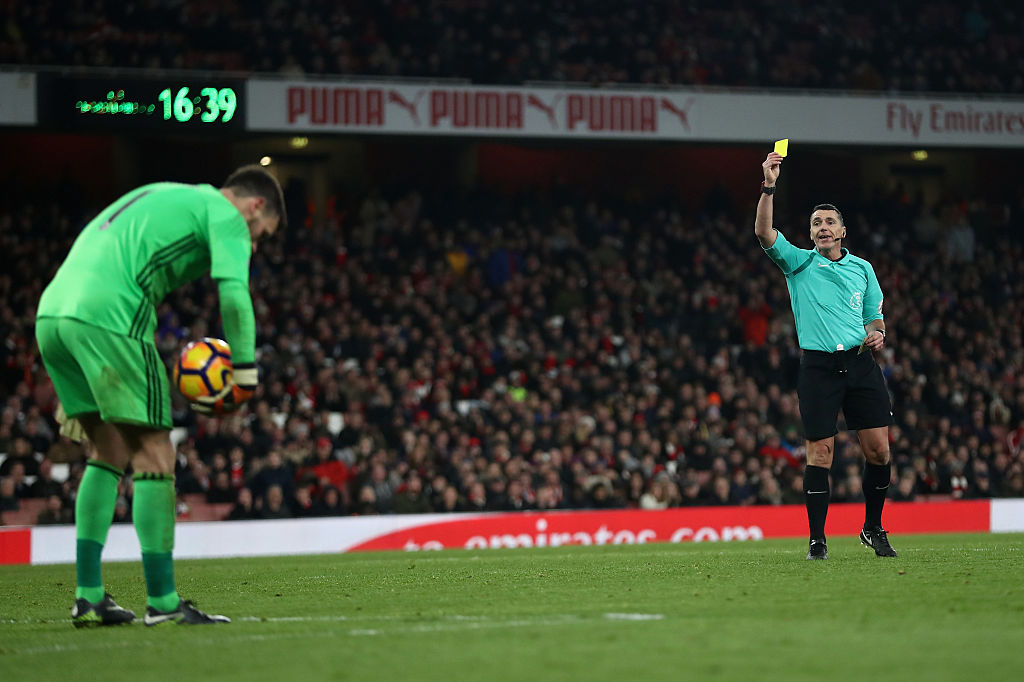
In football, there is no clock to count how much time wasting is done. It is only when the referree deems the player is delaying to restart the play after the ball has gone out of play, or after a foul, for an unacceptable amount of time, then the referree provides a verbal warning. A repeat offense, or several repeat offenses will lead to a yellow card. And, the amount of time the player wasted will be added back into injury time.
Note that football do not have a clock which shows the referree how much time is being wasted each time. That is because, these situations are subjective. If the ball bounces out, and there is no spare ball available, then it is not the fault of the player. Or if a foul occurs and a player is down injured, then any delay is not the fault of the player. There are plenty of situations which can happen which does not mean a player is at fault. A referee will have to use human judgement to determine blatant delays, then warn, and follow it up with a yellow card, if it is warranted. Post match, clubs and players can submit appeals to any decisions and it will be subjected to reviews.
Comparison with Tennis

First of all, badminton seems to be trying to follow tennis. Er, why? Tennis matches can last 6 hours or more. Badminton lasts at most an hour and a half. The penalty in tennis for violating the service clock is a service fault. The player still has a second serve. The clock does not apply to the second serve.
That means the penalty is tennis is not severe. It is the loss of the first serve. Each time a player serves, they can have 2 service faults. If the player violates the service clock, they lose 1 of their service opportunities. If they make a service fault after the service clock violation, that means they lose a point.
What has Badminton done?
BWF has implemented a 25 second service clock, like tennis. But, the penalty is a yellow card, followed by a red card which means automatic award of points to the opponent.
Well, badminton wants to make itself unwatchable. I always thought going 15 points was the way BWF intends to do that. I mean, in the Indonesia Open final, we had entertaining finals, but they just lasted under 40 minutes. The women’s singles final between Akane Yamaguchi and An Se Young lasted 39 minutes, but it was entertaining. The match between Jonathan Christie and Victor Lai was not as entertaining and it lasted also 39 minutes. Imagine playing the 15 x 3 format. It would be under 30 minutes.
The rest of the final matches were entertaining and lasted longer because there was more fight. The mixed doubles was won in straight games by Mathias Christiansen and Alexandra Boje in 46 minutes. It was extremely entertaining. Now, cut that down to just over 30 minutes if done using the 15 x 3 format.
The women’s doubles too was entertaining and lasted 1 hour and 6 minutes. Cut that down to 45 minutes. The men’s doubles was super entertaining and it lasted only 49 minutes. Cut that down to 30 minutes.
In the new 15 x 3 format, finals day will last around 3 hours with the prize giving ceremonies. Sounds like damp squibs already. But wait, what if the focus on the day was on the umpires and not the matches? That is what badminton has done. Bravo.
Umpires penalizing players for time wasting, especially Jonathan Christie. Poor guy. He was standing there ready to serve, and then the umpire calls him over, and warns him not to delay. Huh? What a way to make the guy lose concentration.
This happened numerous times in the earlier rounds too. Goh Soon Huat in mixed doubles probably suffered the most injustice. In the quarterfinals, with the crowd roaring, he was getting ready to serve. The umpire calls him over to give him a red card and award a point to the opponent. At 20 all. In the rubber game.
Conclusion
The fastest racquet sport in the world with matches lasting an average of 40 minutes in the 21 x 3 format, wants to reduce the duration of matches and introduce rules to eliminate time wasting.
What’s the objective here? Reduce the sport to under 30 minutes per match? Make it unwatchable by having the umpire be the star or villain?

https://www.olympics.com/en/news/longest-tennis-match-history-grand-slam-record
Tennis needs it because matches can last for several hours with the average length being 90 minutes. Basketball uses it release the pressure on defensive teams so that they have a chance to attack too. Football uses it because the match is timed to end after 90 minutes, and delaying a restart to run down the clock is unsporting behaviour. What the heck does badminton need this for?
BWF has this tendency of trying to create imaginary problems and fixing it. There are bigger problems which need to be fixed in badminton. Making players suffer more is not one of it.
That’s it for this entry.
Until the next entry, eat well, get plenty of rest and keep the badminton going!
Related Post
Furious and livid. That is how I feel when I read of the latest BWF attempt to ruin badminton. Changing the scoring system when it is working perfectly? Hey, there are other parts of badminton which are broken, and the scoring system is not it. Stop trying to break it, and fix the broken parts…
Streaming Film
Nonton Film gratis
Jasa Backlink
Download Anime Batch